
Advocacy
Know Your Rights
As a minority shareholder, you have legal rights that protect your interests and give you a voice in how companies are governed.
Under the Companies Act 2016, you are entitled to attend, speak, and vote at general meetings; key tools to hold boards accountable and influence corporate decisions. You also have the right to timely, accurate, and reliable disclosures, including annual reports and Bursa announcements, to make informed investment decisions.
At MSWG, we ensure these rights are upheld by monitoring companies, raising concerns, and advocating for greater transparency and accountability, so that your voice is heard, and your rights are truly exercised.
Remember: your rights matter. And when you know your rights, you can help shape better companies and a stronger capital market.
Corporate Monitoring
What We Do
Corporate monitoring is at the heart of our advocacy. We closely monitor over 450 public listed companies across all 12 states in Malaysia, examining their financial performance, business operations, governance practices, and sustainability disclosures.
Our reviews are comprehensive and data-driven. Where concerns arise, we engage directly with the company either by issuing formal letters or by raising the issues during the company’s general meetings. These letters are made available exclusively to our subscribers through our Subscriber Portal.
Ahead of each general meeting, MSWG also publishes a Quick Take, a concise summary highlighting key company developments, proposed resolutions, and matters of interest to minority shareholders. Additionally, we issue our Pre-Voting Decision, which provides MSWG’s stance on each resolution tabled, guided by our published Voting Guidelines.
Advocacy
Newsletter - The Observer
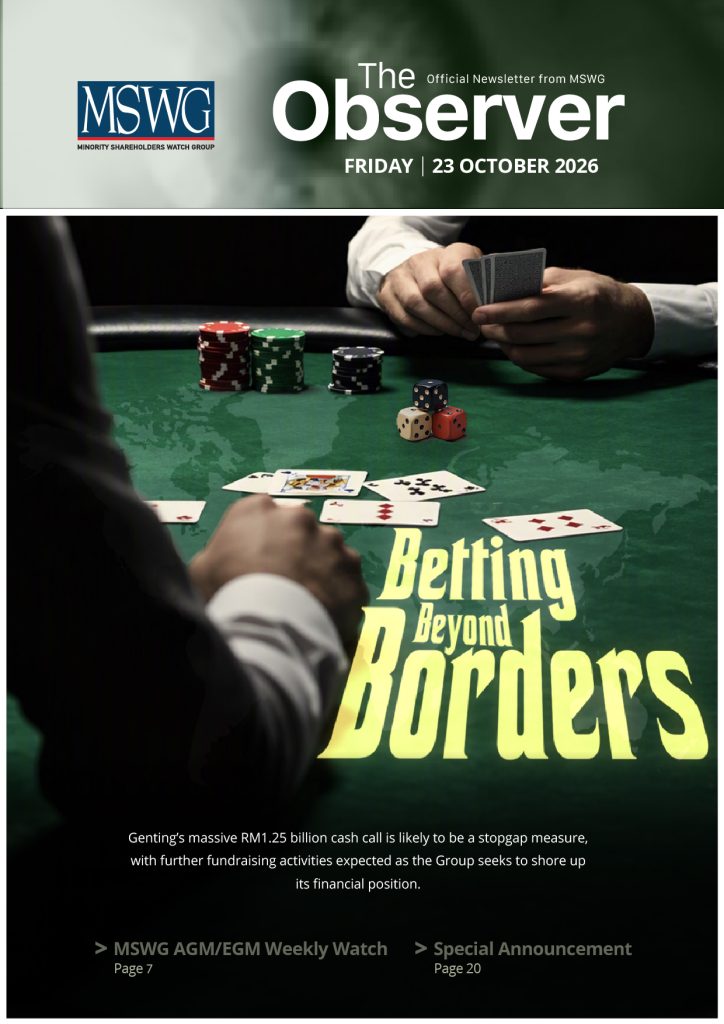
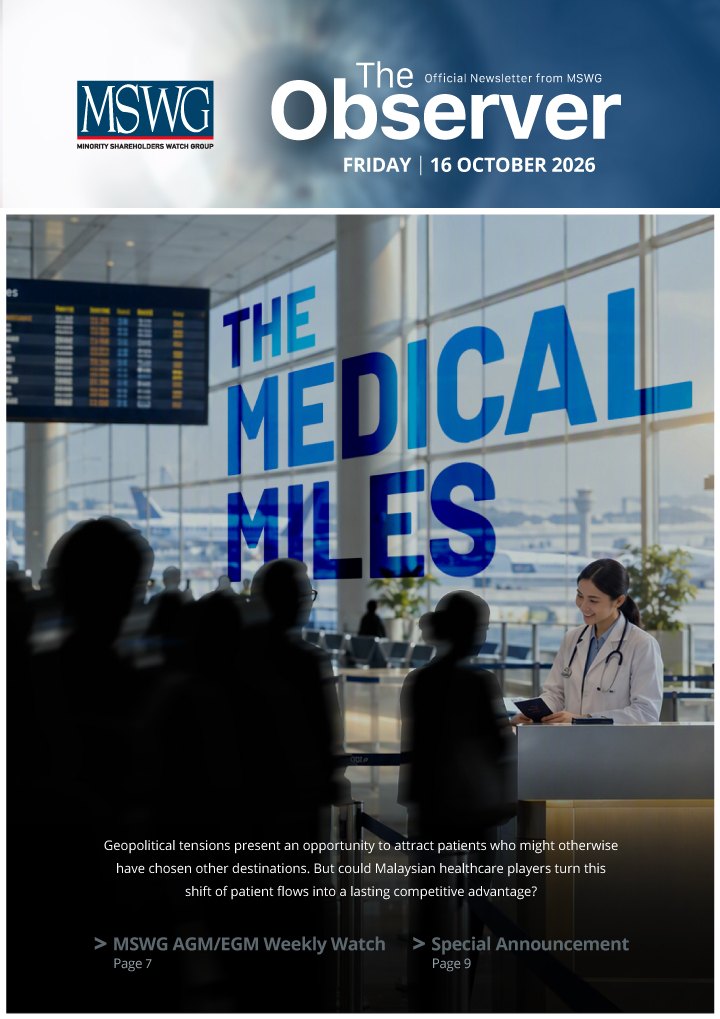
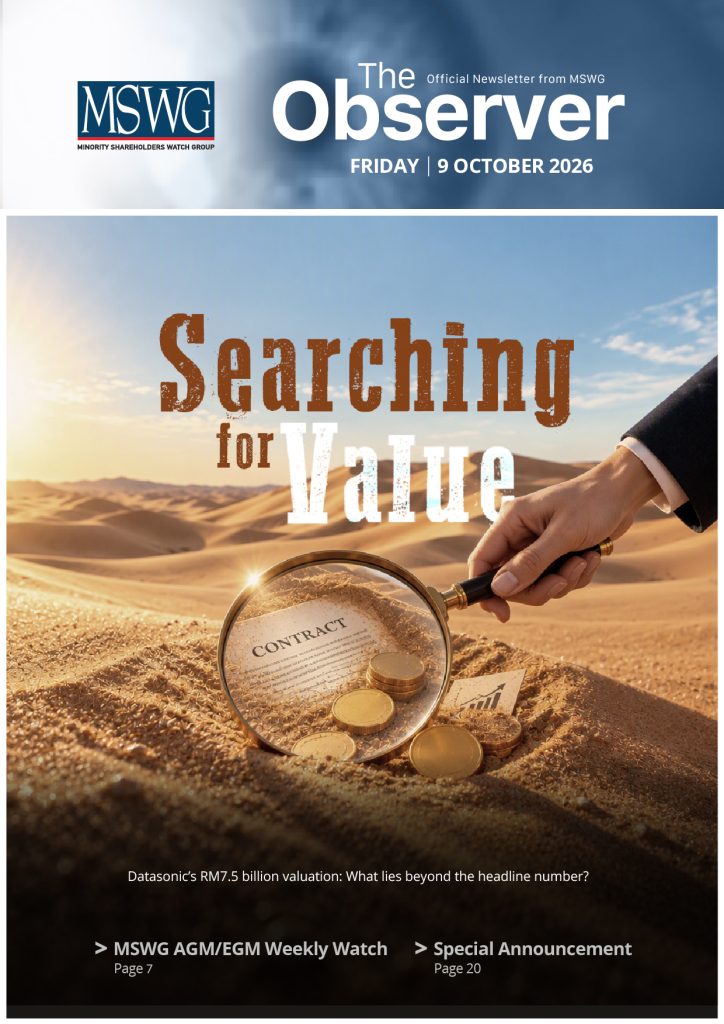
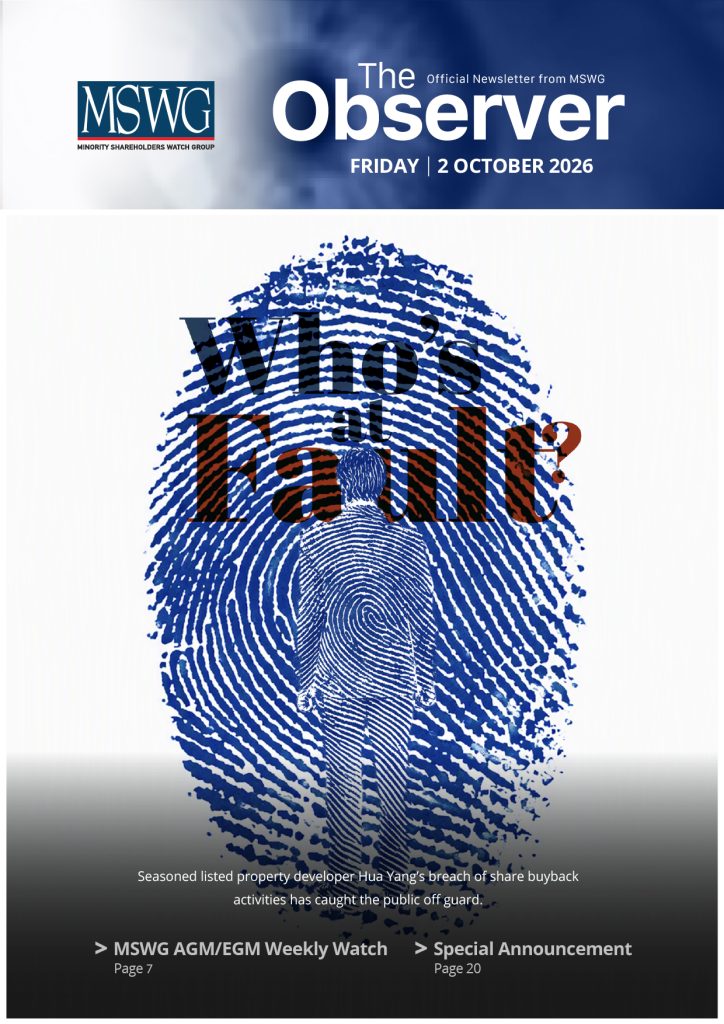
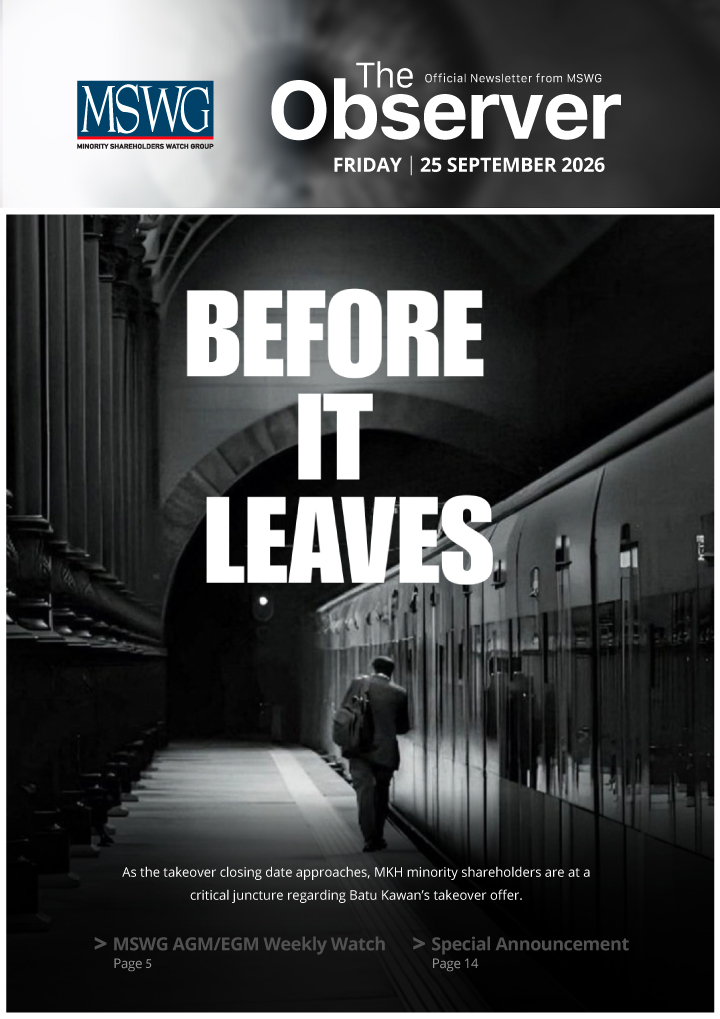
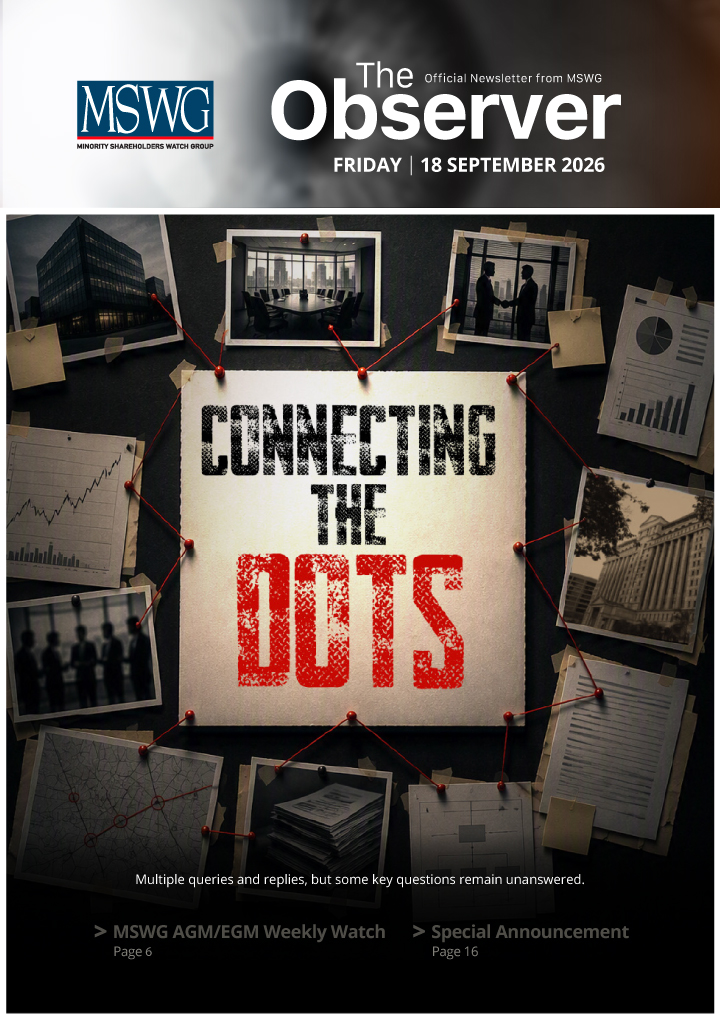
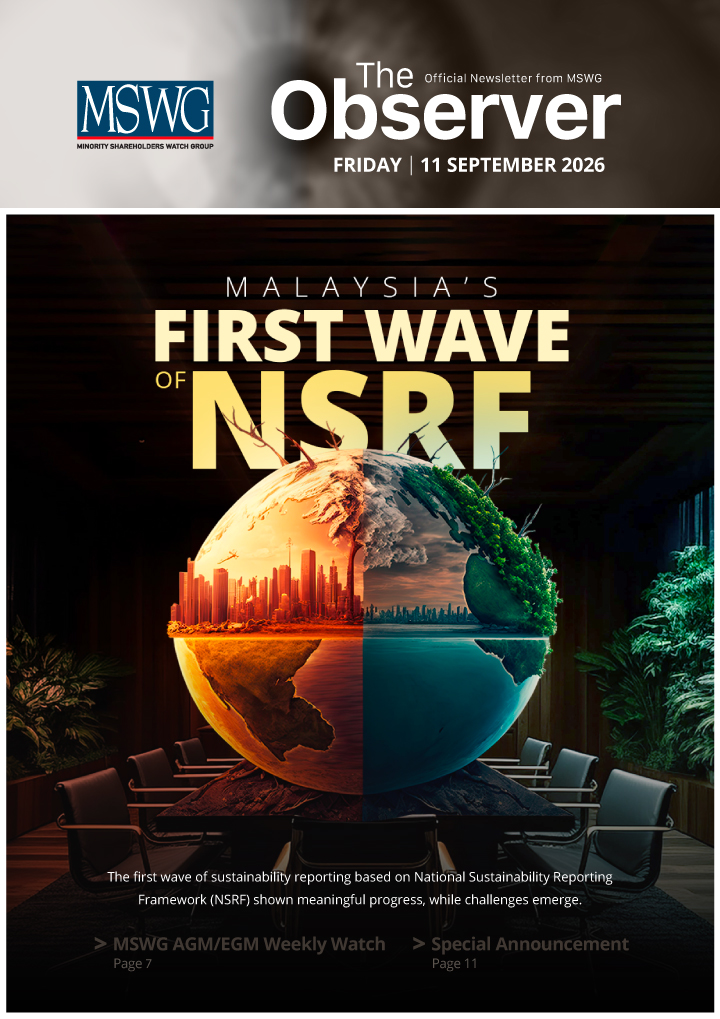
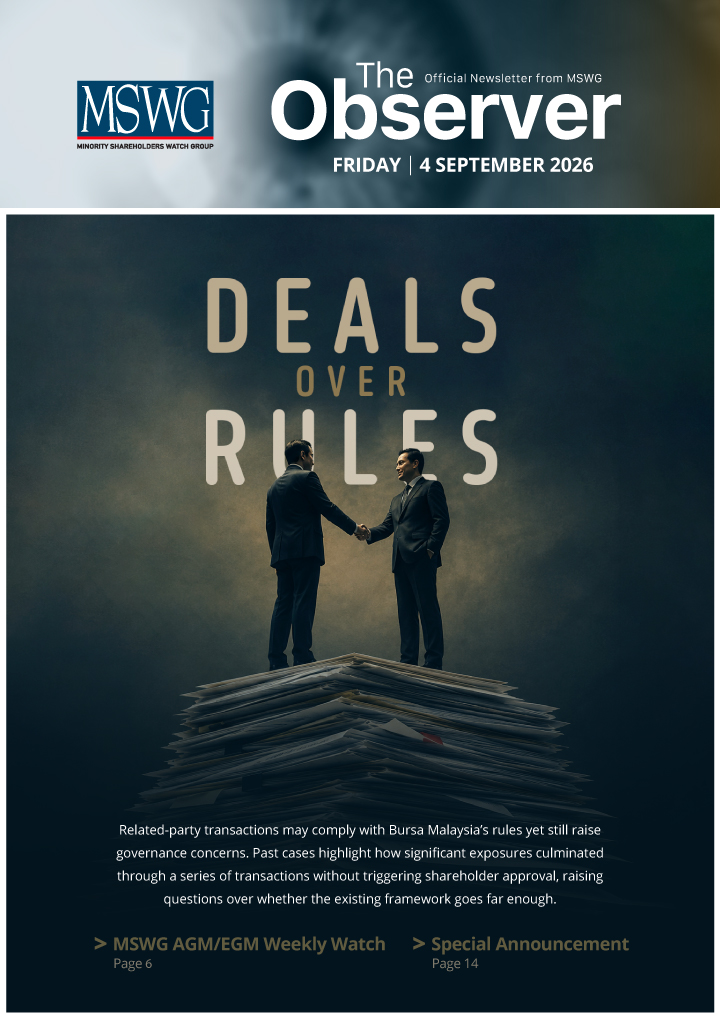
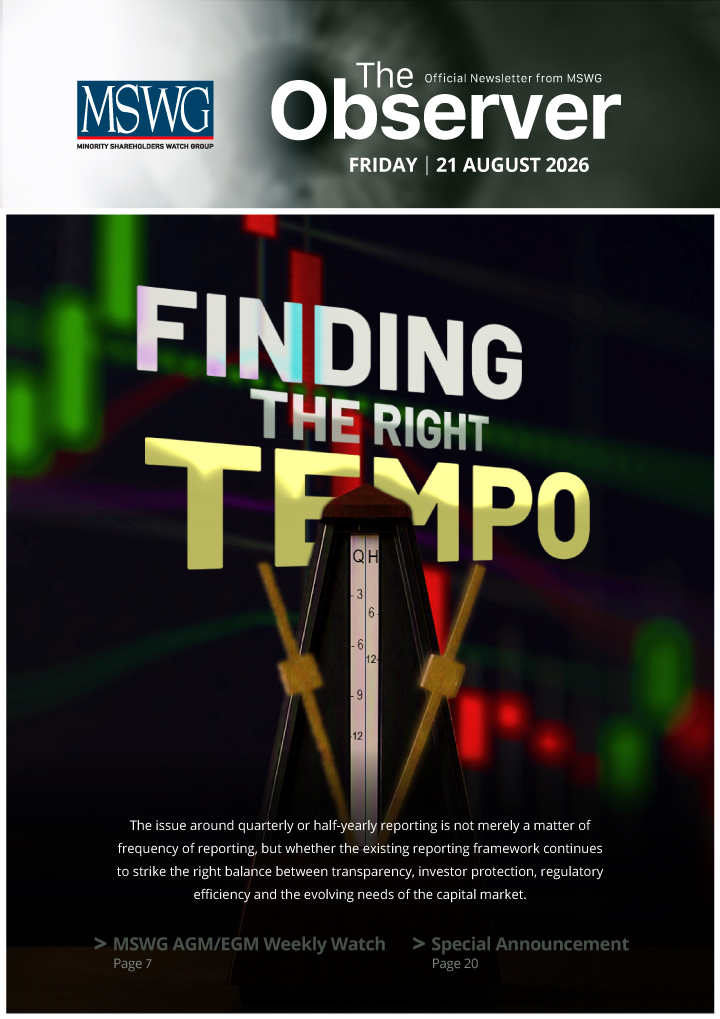
The Observer is MSWG’s weekly newsletter that provides timely insights on corporate governance, shareholder rights, and sustainability developments in Malaysia’s capital market.
Each issue covers red flags from company disclosures, key highlights from general meetings, regulatory changes, and MSWG’s perspectives on emerging trends.
Clear, concise, and purposeful, The Observer is your trusted guide to staying informed and engaged in the evolving governance landscape.

Advocacy
Quick Take
MSWG’s Quick Take offers a timely and concise overview of key issues relating to upcoming general meetings of public listed companies. Each Quick Take highlights material developments, corporate proposals, and resolutions that may impact shareholder rights and interests.
Prepared ahead of company meetings, Quick Takes help minority shareholders quickly grasp the context, identify potential red flags, and focus on matters requiring scrutiny, whether governance concerns, financial irregularities, or ESG implications.
Search by company name or year to explore our archive of Quick Takes.
Stock Code: 7094
Eurospan Holdings Berhad
Date:
Meeting Type: AGM
Group revenue surged to RM188.4 million in FY2026 from RM21.8 million in FY2025, driven mainly by the new construction materials trading business (RM169.0 million). The Group posted a LBT of RM0.8 million against a RM22.4 million profit in FY2025, which included a RM31.3 million disposal gain. Net loss was RM1.7 million.
MSWG will vote FOR all resolutions
Stock Code: 8877
Ekovest Berhad
Date:
Meeting Type: EGM
The Proposed Rights Issue appears to favour Tan Sri Dato’ Lim Kang Hoo (“TSDLKH”) and the persons acting in concert pursuant to subsections 216(2) and/or 216(3) of the Capital Markets and Services Act 2007 (“PACs”). With shares issued at 20 sen, above the 17.5 sen market price at latest practicable date, minority shareholders are unlikely to subscribe. Hence, increasing dilution and enabling TSDLKH or PACs to gain control cheaply at a price far below the 66 sen NA per Ekovest Share (unaudited FY2026).
MSWG will vote AGAINST this resolution.
Stock Code: 0024
JAG Capital Berhad
Date:
Meeting Type: AGM
JAG Capital recorded a 4.9% decline in revenue to RM702.6 million in FY2026, mainly due to a 10.8% decline in LPG revenue amid lower selling prices, a stronger ringgit and slightly lower sales volumes. Revenue from the Cables and Building Materials Division grew by 12.1% to RM208.5 million, partially offsetting the overall contraction. The growth was driven by higher deliveries to core customers and a full financial year of contribution from DOE Industries Sdn Bhd.
Meanwhile, PBZT rose 21.8% to RM56.5 million, aided by improved LPG profitability, a turnaround in Others Division and lower operating expenses.
MSWG will vote AGAINST Resolution 6 on the authority to issue and allot shares, as granting such a mandate while the Group holds substantial net cash of RM451 million without a clear capital deployment strategy could be detrimental to shareholder value.
Stock Code: 5819
Hong Leong Financial Group Berhad
Date:
Meeting Type: AGM
HLFG achieved record financial performance in FY2026 with PATAMI growing 5.5% y-o-y to RM3.435 billion. The Group’s total assets have grown by 4.1% y-o-y to RM369.8 billion as of 30 June 2026.
HLFG’s commercial banking arm, Hong Leong Bank Berhad, remained the largest revenue and profit contributor to the Group, contributing 88% and 87% of revenue and PBT in FY2026, respectively.
MSWG will vote FOR all resolutions
Stock Code: 4758
Ancom Nylex Berhad
Date:
Meeting Type: AGM
Ancom Nylex recorded revenue of RM1.93 billion in FY2026, up 2.8% YoY, while profit before tax (“PBT”) rose 19.6% to RM118.51 million.
Operating cash flow declined to RM43.8 million from RM107.0 million as higher receivables and inventories absorbed working capital, while net gearing increased to 0.40 times.
MSWG will vote FOR all resolutions
Advocacy
Points of Interest
MSWG raises detailed and focused questions to public listed companies on matters of concern ahead of their general meetings. These questions cover a range of issues, including board governance, financial performance, corporate strategy, sustainability commitments, and stakeholder impact.
The complete list of questions submitted by MSWG to each company is available exclusively on our Subscriber Portal.
Stock Code: 8877
Ekovest Berhad
Date:
Meeting Type: EGM
| 1. At the latest practicable date, the share price was RM0.175. That puts the RM0.20 issue price above the theoretical ex-rights price, so minority shareholders have little reason to subscribe. If minority shareholders take up is low, Tan Sri Dato’ Lim Kang Hoo (“TSDLKH”) and the persons acting in concert pursuant to subsections 216(2) and/or 216(3) of the Capital Markets and Services Act 2007 (“PACs”) will hold more than 50% of Ekovest. In this substance, this looks less like a fund-raising and more like a transfer of control. Can the Board address the following:
a) Why did TSDLKH and his PACs decide not to seek an exemption under the Securities Commission’s Take-Overs Code route instead?
b) Will TSDLKH, Ekovest Holdings Sdn Bhd (“EHSB”) and all PACs abstain from voting on this resolution? Did the interested directors abstain when the Board decided to recommend it?
c) Section 2.1 leaves the allocation of excess Rights Shares to the Board’s discretion. Three directors and an alternate director on the Board are PACs of TSDLKH. Who will decide the allocation, and will the interested directors abstain? Will the Board commit to allocating excess Rights Shares to minority shareholders first, with EHSB taking up only what is left? |
Stock Code: 0149
Fibon Berhad
Date:
Meeting Type: AGM
| 1. Under the List of Properties the Group carries a freehold industrial land parcel in Kluang, Johor (HS(D) 75253, PTD 93176) measuring 1,373,475 square feet with a net book value of RM13.713 million, originally acquired on 4 November 2016. This single parcel accounts for 76.39% of total Property, Plant and Equipment (RM17.95 million, Page 83 of AR 2026). Ten years post-acquisition, construction-in-progress stands at RM4.76 million (Page 90 of AR2026).
a) What is the commercial rationale for holding this parcel of land and what is the timeline for its development?
b) How does the Board justify the decade-long period of inactivity? Does this not suggest inefficient land banking, with the prolonged holding of undeveloped land weighing on the Group’s asset turnover?
2. Fibon Capital Sdn Bhd, operating under a moneylending, factoring, and credit financing mandate contributed only RM68,000 in external revenue in FY2026 (FY2025: RM70,000) and generated an operating loss before tax of RM11,000 (Page 117 of AR2026). Moreover, financing debtors stand at RM94,000, 100% of which are contractually past due (Page 101 of AR2026).
What is the strategic rationale for retaining a financial services subsidiary that generates negative returns while continuing to incur regulatory and licensing costs? Has the Board considered surrendering the moneylending licence and divesting the subsidiary to focus on the Group’s advanced composite materials business? |
Stock Code: 0048
Ancom Logistics Berhad
Date:
Meeting Type: AGM
| 1. Despite reporting higher revenue in FY2026 at RM35.2 million (FY2025: RM33.4 million), ALB’s pre-tax profit was down to RM0.7 million compared to RM2 million previously. Both the Chemical Storage and Logistics segments faced operational and cost pressures during the year.
a) While Ancom Nylex Terminals Sdn Bhd (ANT) recorded approximately 24% growth in revenue to RM16.6 million (FY2025: RM13.4 million), its PBT declined to RM4.6 million (FY2025: RM4.7 million), reflecting higher depreciation and financing charges associated with the newly completed tanks, as well as increased maintenance expenses to ensure the operational reliability and safety compliance of its existing facilities.
i. Please provide an update on ANT’s operational performance in FY2026, i.e., the utilisation of the 54,100 cbm tank farm capacity, capacity committed under long-term storage contracts versus spot tank rentals, and the respective contribution of these arrangements to revenue, and whether any major lease has been secured.
ii. While expansion has contributed to revenue growth, the associated depreciation and financing charges, together with higher maintenance expenses, have weighed on ANT’s profitability.
In FY2026, interest expense on lease liabilities increased to RM2.21 million from RM1.71 million, while term loan interest of RM787,000 was also recognised. Meanwhile, lease payments rose by approximately 19% to RM4.54 million from RM3.81 million in the preceding financial year.
Given the substantial and recurring financial commitments associated with the expanded tank farm, these costs could continue to weigh on ANT’s profitability if the additional capacity does not generate sufficient incremental earnings.
b) Despite efforts to broaden customer base, diversify revenue streams and provide value-added services, Cogent’s financial performance remained challenging in FY2026 with lower revenue and deterioration in profitability.
It posted a pre-tax loss of RM1.7 million (FY2025: PBT RM0.1 million) amid intensifying competition, resulting in market share erosion and margin compression. Operating performance was further affected by significantly higher truck repair and maintenance expenses.
i. Given the increasingly competitive operating environment and continued pressure on profit margins, to what extent can Cogent pass on rising operating costs to customers through higher freight rates or contractual price adjustments?
ii. What are management’s key priorities and targets for restoring Cogent’s profitability in FY2027, and when does it expect the segment to return to profitability?
1. External auditor BDO PLT flagged the two subjects below as the Key Audit Matters of the Group (pages 77 – 78 of AR2026):
a) Recoverability of trade receivables
As of 31 May 2026, ALB’s gross trade receivables amounted to RM5.45 million, of which RM871,000 was impaired, representing approximately 16% of the gross carrying amount (page 77 of AR2026).
In addition, the Group recognised a net impairment provision of RM468,000 for trade receivables past due beyond their credit terms in FY2026, compared with only RM20,000 in FY2025 (page 103 of AR2026).
What caused the deterioration in credit collection experience and the quality of its outstanding receivables? Which segment accounts for the bulk of the impaired trade receivables, and what is the ageing profile of these outstanding balances?
ALB did not renegotiate the terms of any trade receivables during the financial year. Does the current collection experience warrant a revision of terms on trade receivables?
In view of the higher impairment provisions and weaker collection experience, will management reassess the adequacy of its existing credit policies to preserve receivables quality?
b) Recoverability of deposits
As of 31 May 2026, gross deposits of the Group and Company amounted to RM2.19 million and RM2.06 million, respectively. During FY2026, the Group and Company recorded a net reversal of impairment of deposits of RM250,000 (FY2025: RM418,000), thanks to the recovery of deposits during the financial year.
Please clarify the total amount of deposits recovered during FY2026, the amount of impairment reversed and the outstanding deposits that remain unrecovered as of 31 May 2026.
Of the outstanding balance, how much has been assessed as recoverable, and what is the expected timeline for recovery?
The Group had previously disclosed that ALB initiated legal action against S7 Holdings Sdn Bhd to recover a deposit. Has S7 consistently met the payment obligation? Please provide an update on the outstanding sum yet to be recovered. |
Stock Code: 0100
ES Ceramics Technology Bhd
Date:
Meeting Type: AGM
| 1. In its response to MSWG queries dated 21 October 2025 in relation to ES Ceramics’ strategy to scale up without overleveraging, the Company stated that it would “strengthen our credit control measures and enhance our credit risk awareness”.
How does the Board explain the increase in impairment losses on receivables from RM2.79 million in FY2025 to RM7.66 million in FY2026 despite these measures? What specific credit controls were introduced, including maximum credit periods, stop-supply thresholds and collateral requirements, and why were they insufficient to prevent the increase in impairment losses? |
Stock Code: 9997
Pensonic Holdings Berhad
Date:
Meeting Type: AGM
| Revenue fell 5.9% to RM314.1 million in FY2026 despite the Group’s efforts to expand its overseas business. Which product categories and markets contributed most to the decline? What specific initiatives will management pursue to restore revenue growth in FY2027?
|